Solar O&M Case Study: 41% Generation Recovery Through Chemical Module Cleaning
Industrial rooftop solar plants operate in complex environments. Unlike open-ground solar plants, rooftop systems installed on manufacturing facilities are often exposed to dust, process fumes, chemical vapours, exhaust emissions, and other site-specific contaminants. Over time, these factors can reduce module transparency, lower energy generation, and affect the overall performance ratio of the plant.
This case study explains how Agni Solar identified and addressed severe module soiling caused by red insulation varnish fume deposition at a 996 kWp rooftop solar PV plant in Chakan, Pune. Through a targeted solar O&M intervention and specialized chemical module cleaning, the plant recorded a 41.1% improvement in average daily energy generation.
Background: 996 kWp Industrial Rooftop Solar Plant in Pune
The site was a 996 kWp rooftop solar PV plant located at an industrial facility in Chakan, Pune. The plant was spread across multiple roof blocks and monitored through SCADA and inverter-level performance data.
As part of routine solar operations and maintenance, Agni Solar observed abnormal underperformance in specific roof blocks. The issue was not uniform across the entire plant. Certain blocks were generating significantly lower energy compared to historical performance trends and expected output.
The affected sections were primarily roof Blocks 3–4 and 5–6, which were located closer to internal production activity. This made the issue highly localized and pointed towards an environmental or process-related cause rather than a plant-wide electrical fault.
The Problem: Red Insulation Varnish Fume Deposition on Solar Modules
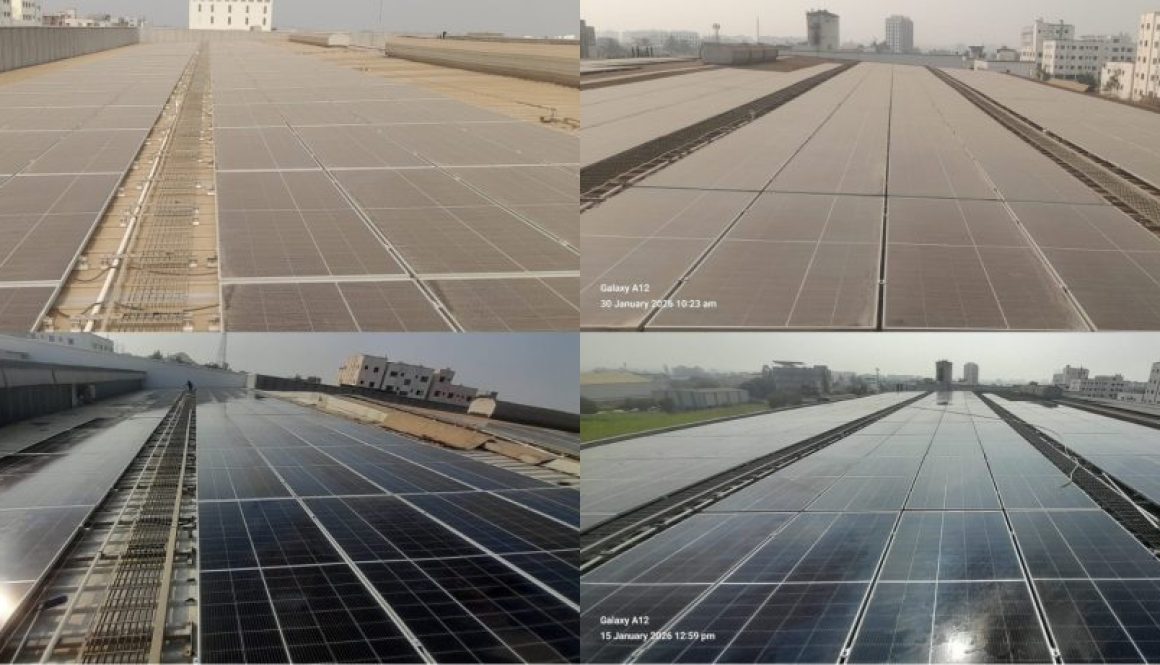
During the site assessment, Agni Solar identified reddish residue on the solar module glass surface. The source was traced to red insulation varnish fumes generated from internal manufacturing processes. These fumes migrated towards the rooftop and settled on the PV module glass.
Over time, the fumes formed a reddish coating on the modules. This coating reduced glass clarity and lowered optical transmittance, meaning less sunlight was able to reach the solar cells.
This type of soiling is different from normal dust accumulation. In many cases, regular water cleaning may not be sufficient because the residue forms a more persistent layer on the module surface. If not addressed quickly, such contamination can lead to continued generation loss and revenue impact.
Pre-Cleaning Observations
Before the corrective cleaning activity, the following issues were observed:
- Visible reddish discoloration on solar module glass
- Reduced transparency and increased surface haze
- Soiling that was not removed effectively by normal water cleaning
- Reduced daily energy generation
- Degraded Performance Ratio, also known as PR
- Inverter-wise underperformance in affected roof blocks
- Deviation from historical and expected performance trends
The visual condition of the modules clearly indicated that the issue was related to surface contamination. However, visual observation alone was not enough. Agni Solar also analyzed inverter-level and plant-level performance data to confirm the impact on energy generation.
Corrective Action: Targeted Chemical Module Cleaning
Based on the site condition and performance data, Agni Solar carried out corrective module cleaning between 02 January and 05 January 2026.
The cleaning was focused mainly on the most affected roof blocks: Blocks 3–4 and 5–6. Approximately 1,230 solar modules were cleaned using a water-soluble chemical cleaning method.
The activity included:
- Manual chemical cleaning of affected modules
- Use of water quality as per O&M guidelines
- Focused cleaning of high-impact roof blocks
- Electrical isolation during cleaning work
- Work-at-height safety compliance
- Post-cleaning performance monitoring
The objective was to remove the varnish-based residue, restore module glass clarity, improve sunlight absorption, and recover lost energy yield.
Performance Analysis: Before vs After Cleaning
To measure the effectiveness of the cleaning activity, Agni Solar compared plant performance before and after cleaning.
Pre-cleaning period: 29 December 2025 to 01 January 2026
Post-cleaning period: 06 January 2026 to 09 January 2026
The results showed a major recovery in plant-level performance.
|
KPI |
Pre-Cleaning Average |
Post-Cleaning Average |
Improvement |
|
Energy Generation |
2,536.9 kWh/day |
3,579.7 kWh/day |
+41.1% |
|
Irradiation |
3.21 kWh/m²/day |
3.34 kWh/m²/day |
+4.1% |
|
Specific Yield |
2.55 kWh/kWp/day |
3.59 kWh/kWp/day |
+41.0% |
|
Performance Ratio |
79.5% |
107.7% |
+35.4% |
The most important insight is that irradiation increased by only 4.1%, while energy generation improved by 41.1%. This confirms that the performance recovery was not simply due to better sunlight conditions. The dominant cause of the pre-cleaning loss was module soiling caused by varnish fume deposition.
Block-Wise Performance Recovery
The improvement was especially visible in the roof blocks that had been most affected by the fume deposition.
|
Roof Block |
Pre-Cleaning Average |
Post-Cleaning Average |
Improvement |
|
Block 3–4 |
634.4 kWh/day |
938.9 kWh/day |
+48.0% |
|
Block 5–6 |
850.1 kWh/day |
1,365.5 kWh/day |
+60.6% |
Block 5–6 showed the highest recovery at 60.6%, confirming that this section had experienced the most severe impact from fume-related soiling.
This block-wise improvement also helped confirm that the problem was not caused by a general inverter defect or electrical issue. Instead, the recovery pattern matched the areas exposed most heavily to the industrial fumes.
Inverter-Wise Performance Recovery
Inverter-level monitoring gave a more detailed view of how the affected sections recovered after cleaning.
|
Inverter |
Roof Block |
Pre-Cleaning Average |
Post-Cleaning Average |
Improvement |
|
Inverter 3 |
Block 3–4 |
328.8 kWh/day |
483.9 kWh/day |
+47.5% |
|
Inverter 4 |
Block 3–4 |
306.0 kWh/day |
454.9 kWh/day |
+48.7% |
|
Inverter 5 |
Block 5–6 |
254.1 kWh/day |
455.9 kWh/day |
+79.4% |
|
Inverter 6 |
Block 5–6 |
280.9 kWh/day |
456.3 kWh/day |
+62.4% |
|
Inverter 7 |
Block 5–6 |
314.6 kWh/day |
453.4 kWh/day |
+44.1% |
Inverter 5 showed the highest recovery at 79.4%. This level of improvement highlights the value of inverter-level performance monitoring in solar O&M. Without such monitoring, localized issues can remain hidden and continue to reduce energy yield.
Why Normal Cleaning Was Not Enough
In many rooftop solar plants, periodic water cleaning is sufficient to remove dust and loose particles. However, industrial environments can create more complex forms of soiling.
In this case, the residue was caused by red insulation varnish fumes. The coating was more persistent than ordinary dust and reduced module glass transparency. As a result, standard cleaning was not effective enough to restore performance.
This is where professional solar O&M services become critical. A trained O&M team can identify the nature of the soiling, evaluate whether normal cleaning is sufficient, recommend the correct cleaning method, and validate results through performance data.
What This Case Study Shows About Solar O&M
This case study highlights an important point: solar O&M is not limited to routine cleaning. Effective solar operations and maintenance requires a structured technical approach.
A professional solar O&M service provider should be able to:
- Monitor plant performance continuously
- Compare actual generation against expected generation
- Identify block-wise and inverter-wise deviations
- Diagnose environmental and process-related causes of underperformance
- Recommend preventive or corrective maintenance actions
- Execute cleaning safely and correctly
- Validate recovery through KPI analysis
- Protect long-term energy yield and asset reliability
In this case, the O&M intervention helped restore module clarity, recover daily generation, improve specific yield, and normalize plant performance indicators.
Business Impact of Timely Solar O&M Intervention
For commercial and industrial solar plants, generation loss directly affects savings and return on investment. Even a small reduction in daily generation can create a significant revenue impact over weeks or months.
The 41.1% recovery in average daily generation shows how important it is to identify and resolve performance issues quickly. If the fume deposition had remained untreated, the plant would have continued to operate below its potential.
Timely solar O&M helps businesses:
- Reduce generation losses
- Improve plant availability
- Protect solar ROI
- Extend asset life
- Identify issues before they become major failures
- Maintain predictable energy savings
- Improve confidence in long-term plant performance
For industrial rooftops, this is especially important because production-related emissions, dust, fumes, and heat can all affect the performance of solar assets.
Key Learnings from the Case Study
This project offered several practical learnings for commercial and industrial solar plant owners.
First, soiling losses are not always caused by dust. In industrial locations, fumes and process emissions can create more serious contamination on solar modules.
Second, localized underperformance should not be ignored. If only certain roof blocks or inverters are affected, the root cause may be linked to site layout, nearby emission sources, shading, equipment issues, or cleaning gaps.
Third, chemical cleaning should be used carefully and only when required. The cleaning method must be suitable for solar module glass and should follow proper O&M and safety guidelines.
Fourth, performance validation is essential. Cleaning activity should not end with visual inspection. The real success of an O&M intervention must be confirmed through data such as generation, specific yield, irradiation, and PR.
Conclusion
The red insulation varnish fume deposition had a direct and measurable impact on the performance of the 996 kWp rooftop solar PV plant. The affected modules showed visible reddish residue, reduced glass clarity, and significant loss in energy generation.
Through targeted chemical module cleaning, Agni Solar restored the affected module surfaces and achieved immediate performance recovery. Average daily energy generation improved by 41.1%, specific yield improved by 41.0%, and Performance Ratio improved from 79.5% to 107.7%.
This case study demonstrates the value of data-driven solar O&M services for commercial and industrial solar plants. With the right monitoring, diagnosis, corrective action, and post-cleaning validation, plant owners can protect energy yield, improve returns, and ensure long-term reliability of their solar assets.
Need Solar O&M Support for Your Commercial or Industrial Plant?
Is your rooftop solar plant generating less than expected?
Agni Solar provides professional solar O&M services for commercial and industrial solar plants, including performance monitoring, preventive maintenance, corrective maintenance, module cleaning, fault diagnosis, inverter-level analysis, and energy-yield improvement.