
From Sunbeams to Savings: The Journey of SolarPower
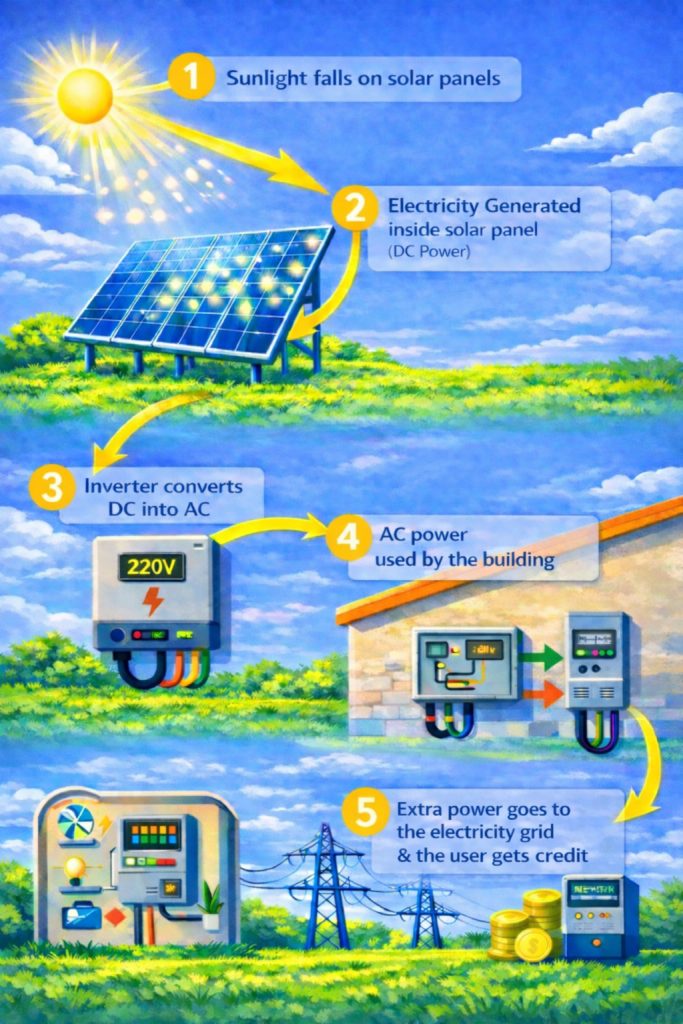
Have you ever looked up at a roof lined with those sleek, dark blue/black rectangles and wondered, “How exactly does a beam of light traveling 93 million miles through space end up powering my coffee maker?”
It feels like magic. There are no moving parts, no smoke, no noise. Just a silent slab of glass and silicon sitting in the sun, churning out the same electricity that coal plants burn tons of fuel to produce.
But it isn’t magic, it’s physics. And the best part? The process is surprisingly elegant.
This journey is a marvel of modern engineering, bridging the gap between the infinite energy of the stars and the simple comforts of home. By capturing the sun’s raw potential, we aren’t just generating power; we are participating in a quiet revolution that redefines our relationship with the environment.
We will go beyond the basics, diving into the “how” and “why” of each step, transforming this scientific process into a clear, understandable narrative.
Buckle up. We are following the photon’s journey from the surface of the sun to the socket in your wall.
The Source – Sunlight Falls on Solar Panels
“The sun provides more energy to the Earth in one hour than the entire world consumes in a year.”
The process begins, quite literally, at the dawn of the day. The bright sun casts its rays onto the solar panels on the roof. This seems obvious, but there is a fascinating atomic interaction happening here.
The Photon Bombardment
Sunlight isn’t just “brightness”; it is composed of tiny packets of energy called photons. When these photons slam into your solar panels, they are the fuel for the engine.
These subatomic travelers have spent eight minutes racing across the vacuum of space, carrying enough punch to jar electrons loose the moment they make contact. It is a relentless, microscopic rain of energy that transforms your roof into a high-tech harvester, capturing cosmic power that would otherwise simply bounce away.
However, not all sunlight is created equal. Solar panels work best with direct sunlight, but they can still generate power on cloudy days (though less efficiently) because Solar panels generate electricity from photons across parts of the visible and infrared spectrum, not from heat itself.”. In fact, solar panels actually prefer cooler temperatures! Excessive heat can reduce their efficiency, which is why a sunny, breezy spring day is often better for production than a scorching mid-summer afternoon.
The Angle Matters
Have you noticed how the solar panels are always tilted? They are angled to catch the maximum amount of those photons. In the Northern Hemisphere, panels usually face South; in the Southern Hemisphere, they face North. This maximizes the “exposure time” step 1 requires to kickstart the entire chain reaction.
The Engine – Electricity Created Inside Solar Panel (DC Power)
Here is where the real action happens.
The Photovoltaic (PV) Effect
Solar panels are made up of many smaller units called solar cells, typically made of silicon. Silicon is a semiconductor, meaning it can conduct electricity under specific conditions.
Think of a solar cell like a sandwich. It has two layers of silicon:
- N-Type Layer: Loaded with extra electrons (negative charge).
- P-Type Layer: Has holes for electrons (positive charge).
This “sandwich” structure is critical because the interaction between these two layers creates a permanent internal electric field. It acts like an invisible slope or a slide, waiting for something to give the electrons a push so they can start moving.
When the photons strike the silicon cell, they transfer their energy to the electrons in the silicon atoms. This energy knocks the electrons loose from their atomic orbit.
Because of an internal electric field created by the N-type and P-type layers, these loose electrons are forced to move in one specific direction. Without this built-in field, the jarred electrons would simply wander aimlessly and eventually settle back into their original spots. Instead, the cell captures their energy by channeling them into an organized stream.
The Flow of Traffic (Direct Current)
This directional movement of electrons is what we call electricity. Specifically, it is Direct Current (DC).
In DC power, electrons flow in a single direction, like cars on a one-way highway.
- The Good News: This is a very stable way to generate power.
- The Bad News: Our homes, appliances, and the main electricity grid do not run on DC power. They run on AC (Alternating Current).
So, at the end, we have successfully harvested energy from the sun, but it is currently in a “raw” format. It’s like having crude oil when your car needs gasoline. We need to refine it.
The Inverter – Inverter Converts DC into AC
If the solar panels are the heart of the system (pumping the energy), the inverter is the brain.
Why Do We Need to Convert?
Thomas Edison was a fan of DC power, but Nikola Tesla won the “War of Currents” with AC power because it travels long distances more efficiently. Today, almost every appliance in your house from your TV to your toaster is built to accept Alternating Current (AC), where the electrons vibrate back and forth rather than flowing in a straight line.
If you skipped the inverter and plugged your TV straight into the panels, the only show you’d get is a loud sizzle. This is because your household electronics are designed for a specific rhythm of energy that the raw DC output simply cannot provide. The inverter acts as a high-speed translator, bridging the gap between the sun’s steady flow and your home’s vibrating demand.
The inverter takes that one-way stream of DC electrons coming from the roof and rapidly switches their direction back and forth, 50 or 60 times a second (depending on your country’s grid frequency).
Smart Inverters
Modern inverters do more than just convert power.
They also:
- Monitor Performance: They track how much energy your system is producing. By providing real-time data to your smartphone or computer, they allow you to see exactly how your “mini power plant” is performing at any given moment.
- Safety Shutdown: If the main power grid goes down (during a blackout), the inverter instantly shuts off the solar system to prevent electrocuting utility workers fixing the lines. This “anti-islanding” feature is a crucial fail-safe that ensures your system doesn’t accidentally send electricity back into a damaged grid where people are working. It makes the entire transition to renewable energy safer for everyone involved.
Self-Consumption – AC Power Used by the Building
Now that the power has been “translated” into a language your home understands (AC), it flows into your electrical panel (breaker box). This leads us to the next phase.
The Path of Least Resistance
Electricity behaves like water; it follows the path of least resistance. When your solar system is generating power, that electricity flows directly into your home’s circuits before drawing anything from the utility grid. This happens instantaneously and automatically, without you needing to flip a single switch. Your home’s appliances will always “drink” from the solar supply first because it is the closest and most accessible source of energy available to your internal wiring.
What is running on Solar?
During the day, if your panels are producing 4 kilowatts (kW) of power and your AC unit, fridge, and computer are consuming 3 kW combined:
- 100% of your energy comes from your roof.
- Your electric meter stops spinning forward.
- You are effectively “off-grid” for that moment, even though you are still physically connected.
This is the ultimate goal of any residential system: maximizing self-sufficiency. By aligning your heavy energy tasks like doing laundry or running the dishwasher—with the peak hours of the afternoon, you ensure that you are squeezing every bit of value out of the sun. You aren’t just saving money; you are essentially insulating yourself from rising energy costs by becoming your own primary provider. This is where the immediate financial savings happen. Every kilowatt-hour (kWh) you generate and use yourself is a kWh you didn’t have to buy from the electric company.
The Bonus – Extra Power Goes to the Electricity Grid
This is the step that makes modern solar power so financially attractive.
The Problem of “Surplus” Power
Solar production follows a bell curve. You produce the most power at noon. However, most people aren’t home at noon; they are at work or school. This creates a mismatch:
- Production: High at midday.
- Consumption: Low at midday.
Without the grid, this extra energy would just go to waste (unless you have expensive batteries). By being connected to the utility network, your home becomes a vital part of a larger energy web. Instead of that midday surge of energy disappearing, it is redirected where it is needed most, turning your roof into a clean energy provider for your entire street.
Net Metering: The Grid as a Battery
When your system produces more energy than your house is currently using, the excess electricity flows out of your house and onto the public electric grid to power your neighbours’ homes.
When this happens, your electric meter actually spins backwards. This effectively turns the utility grid into a massive, free “virtual battery.” You store your excess value there during the day, not as physical electrons, but as financial data that offsets your future costs.
The Financial Benefit
The utility company credits you for this power.
- Daytime: You send power to the grid (earning credits).
- Nighttime: The sun goes down, and you pull power from the grid (spending credits).
At the end of the month, you are only billed for the “Net” difference. If you produced as much as you used, your bill could be zero (or just a small connection fee). Your roof has effectively become a mini power plant, generating revenue. This symbiotic relationship between your home and the grid ensures that no photon is ever wasted. It transforms the way we think about utilities moving from a one-way street of buying power to a two-way exchange that rewards you for your contribution to a greener planet.
The Solar Snapshot:
- Capture: Nature delivers free energy (Photons).
- Generation: Physics converts it to raw electricity (DC).
- Transmission: Technology adapts it for human use (AC).
- Consumption: You lower your bills by using it first.
- Contribution: You share the excess with the community and gain financial credit.
Why This Matters
Understanding this 5-step mechanism is the key to understanding the energy transition. It’s not just about “being green” though the environmental benefits of reducing carbon emissions are massive. It is about energy independence.
By installing this system, you are no longer just a passive consumer of electricity; you are a prosumer (producer + consumer). You are taking the infinite power of the star at the center of our solar system and using it to run your life. This shift represents a fundamental change in our relationship with energy. Instead of being tethered to a distant, fluctuating market, you are tapping into a predictable and democratic resource. You are essentially claiming your own small piece of the grid, providing a sense of security and resilience that traditional power sources simply cannot match in an age of rising costs and climate uncertainty.
The Future is Bright
Technology is only improving. Panels are getting more efficient, squeezing more power out of every square inch of roof space. Inverters are getting smarter, managing complex home ecosystems with the precision of a computer. Batteries are becoming more affordable, allowing you to store your sunlight for the darkest hours of the night instead of exporting it.
We are moving toward a world where every building is its own power station, interconnected in a smart, resilient web that shares energy across neighbourhoods seamlessly. This evolution isn’t just about better gadgets; it’s about a smarter way of living on this planet.
But the soul of the system never changes: a billion-year-old star whispering to a sheet of silicon, and a house coming to life in the silence. It is a partnership between the cosmic and the domestic a daily miracle that happens right above your head.