
Temperature Management: The Key to Reliable Battery Performance.
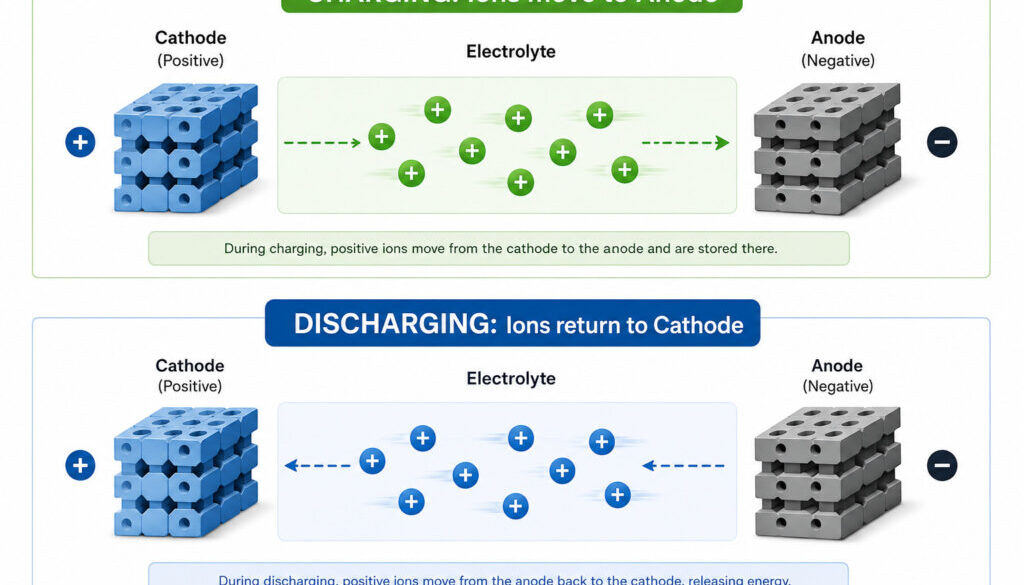
When we talk about solar energy and battery storage, the conversation usually revolves around a few familiar metrics: kilowatt-hours (kWh), discharge rates, and payback periods. We meticulously calculate how many panels it takes to cover the evening peak, and we check the weather app to see if cloudy days will impact our self-sufficiency.
But there is a hidden, silent variable that has a massive impact on your system’s performance, efficiency, and ultimate lifespan. It isn’t the lack of sunlight, and it isn’t manufacturing quality.
It’s the temperature.
Batteries are fundamentally chemical engines wrapped in digital armor. Because they rely entirely on chemical reactions to store and release electricity, they are highly sensitive to the ambient environment. Install a premium battery bank in a hot, unventilated attic or a freezing, exposed outdoor shed, and you might accidentally cut its usable life in half.
If you want to protect your clean energy investment, you need to understand how temperature impacts battery health and how proper engineering can keep your system running smoothly for decades.
- Weatherproof Your Power: How Temperature Affects Storage
To understand why temperature matters, we have to look inside the battery cell. Whether you are using traditional lead-acid batteries or modern Lithium Iron Phosphate (LFP) modules, a battery doesn’t actually store raw electricity. It stores chemical energy.
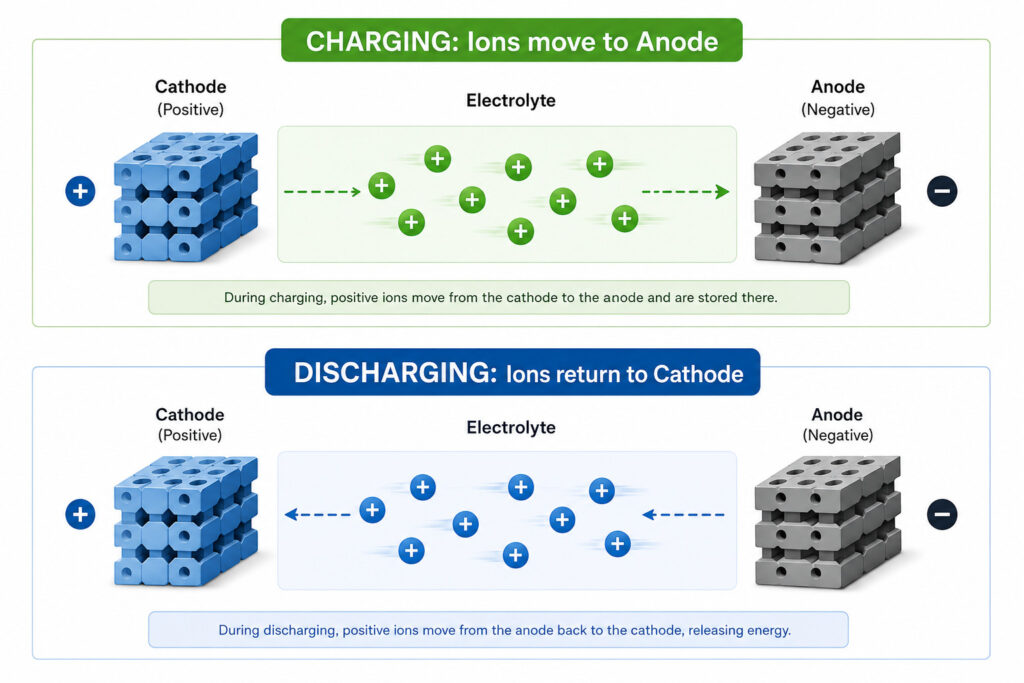
When you charge a battery, electrical current forces ions to move from one electrode (the cathode) to another (the anode). When you discharge it to power your lights or air conditioning, those ions flow back, releasing electrons along the way.
Because this is a chemical process, it is strictly governed by the laws of thermodynamics. In chemistry, a common rule of thumb—derived from the Arrhenius Equation—states that many chemical degradation reactions accelerate significantly with increasing temperature. A common engineering rule of thumb is that degradation rates approximately double for every 10°C rise.
- When it’s hot: Chemical reactions happen much faster. On paper, this actually increases the battery’s temporary capacity and makes it highly responsive. However, it also accelerates unwanted, destructive side-reactions inside the cell (like internal corrosion and electrolyte breakdown).
- When it’s cold: At low ambient temperatures, electrochemical reaction kinetics significantly decrease. The increased viscosity of the internal electrolyte creates higher internal resistance, severely impeding ion transport between the electrodes.
Most stationary solar batteries are designed to perform optimally at a comfortable room temperature: 25℃ (77℉). This is the baseline “sweet spot” where capacity, efficiency, and longevity balance perfectly. Move too far in either direction, and things start to degrade.
- Too Hot to Handle: The High-Temperature Hazard
In many regions, particularly across India during intense summer months, extreme heat is the primary enemy of battery longevity.
When a battery bank is consistently exposed to ambient temperatures hovering above 35℃ to 40℃ (95℉ to 104℉) the accelerated chemistry inside the cells causes permanent, irreversible damage known as calendar aging.
The Cost of Chronic Overheating
Every sustained increase in temperature above the 25℃ baseline acts as a time-compressor for your battery’s lifespan. For instance, consistently operating a traditional lead-acid battery, every sustained 8–10°C increase above 25°C can approximately halve service life.
While modern Lithium-ion chemistries (especially LFP) are significantly more resilient to heat than older lead-acid designs, they are not immune. High heat causes:
- Accelerated Self-Discharge: The battery loses its stored energy faster while just sitting idle.
- Electrolyte Degradation: The internal medium that allows ions to move begins to break down, permanently reducing the total amount of energy the battery can hold.
- SEI Layer Growth: In lithium batteries, a protective layer called the Solid Electrolyte Interphase (SEI) naturally forms on the anode. Excessive heat causes this layer to grow too thick, consuming active lithium ions and increasing internal resistance.
The Ultimate Risk: Thermal Runaway
Aside from premature degradation, extreme heat poses a structural safety risk. When a battery charges or discharges heavily, it naturally generates internal heat (due to Joule heating). If the ambient air is already scorching and there is no ventilation, the battery cannot dissipate this heat.
If internal temperatures cross a critical threshold, it can trigger thermal runaway—a catastrophic chain reaction where the heat generated inside the cell exceeds the amount of heat it can release, causing the cell to rupture, vent smoke, or in extreme scenarios, catch fire.
- Caught in the Cold: The Low-Temperature Logjam
While heat destroys a battery slowly over time, extreme cold impacts performance instantly. If you live in a high-altitude area or experience bitter winters, cold temperatures present an entirely different set of operational challenges.
Sluggish Ions and Dropping Capacity
When ambient temperatures plunge toward freezing (0℃ or below), the internal resistance of the battery spikes. Because the ions cannot move freely through the sluggish electrolyte, the battery struggles to deliver power.
- At 0℃ (32℉), a standard solar battery might experience a 20% drop in effective capacity.
- At -20℃ (-4℉), that capacity can plummet by 50% or more.
If you try to draw a heavy load (like starting a water pump or heavy appliance) from a freezing battery, the voltage will instantly drop, potentially causing your solar inverter to assume the battery is empty and shut down, leaving you without backup power even if the cells are technically charged.
The Danger of “Lithium Plating”
There is a massive distinction in how cold impacts a battery depending on whether it is discharging or charging:
- Discharging a cold battery reduces its capacity temporarily, but it generally doesn’t cause permanent damage. As the battery works, internal resistance will naturally generate a little heat, warming the cells up.
- Charging a lithium battery below freezing is highly dangerous.
When you force current into a freezing Lithium-ion cell, the ions move too slowly to neatly tuck themselves into the anode’s structure. Instead, they accumulate on the surface of the anode, turning into literal metallic lithium. This process is called lithium plating.
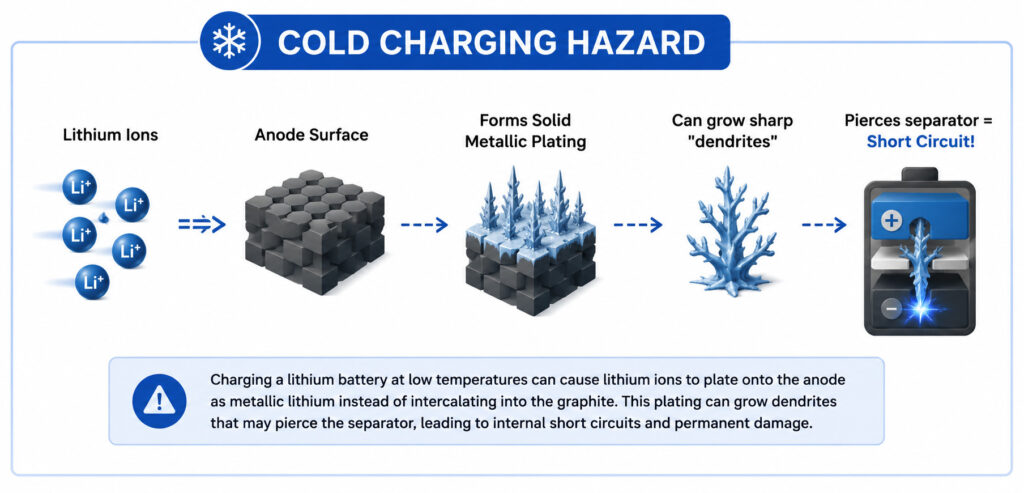
Lithium plating is permanent and severe. Over time, these microscopic metallic deposits can grow into sharp needles called dendrites. If a dendrite grows long enough to pierce the internal separator film between the positive and negative sides of the battery, it causes an instantaneous internal short circuit, destroying the cell instantly and creating a serious fire hazard.
- Chemistry Showdown: How Different Batteries Handle the Heat
Not all batteries react to temperature changes in the same way. The two most prominent choices for modern solar storage—Lead-Acid/Lead-Carbon and Lithium Iron Phosphate (LFP)—have vastly different thermal profiles.
|
Feature |
Lead-Acid / Lead-Carbon |
Lithium Iron Phosphate (LFP) |
|
Ideal Temperature Range |
20℃ to 25℃ |
15℃ to 30℃ |
|
High Heat Resilience |
Poor (Lifespan halves every 8℃ to 10℃ rise) |
Moderate-High (Degrades faster, but handles up to instant failure) |
|
Sub-Freezing Charging |
Permissible (with voltage compensation) |
Strictly Forbidden by default (unless equipped with internal heaters) |
|
Thermal Protection |
Passive (Relies on external charge controller settings) |
Active (Managed continuously by an intelligent internal BMS) |
Traditional lead-acid systems require temperature-compensated charging. Because their chemical voltage profile changes depending on how warm they are, a smart solar charge controller must actively lower the charging voltage as the battery gets warmer to prevent it from boiling off its water or gassing excessively.
LFP systems, on the other hand, rely on an intelligent: the Battery Management System (BMS).
- The First Line of Defense: The Battery Management System (BMS)
Modern solar battery storage systems aren’t just blocks of raw chemical material; they are highly sophisticated, digitally managed appliances. The unsung hero of thermal protection is the Battery Management System (BMS).
The BMS acts as a digital guard that continuously monitors internal temperature sensors embedded deep inside the battery modules.
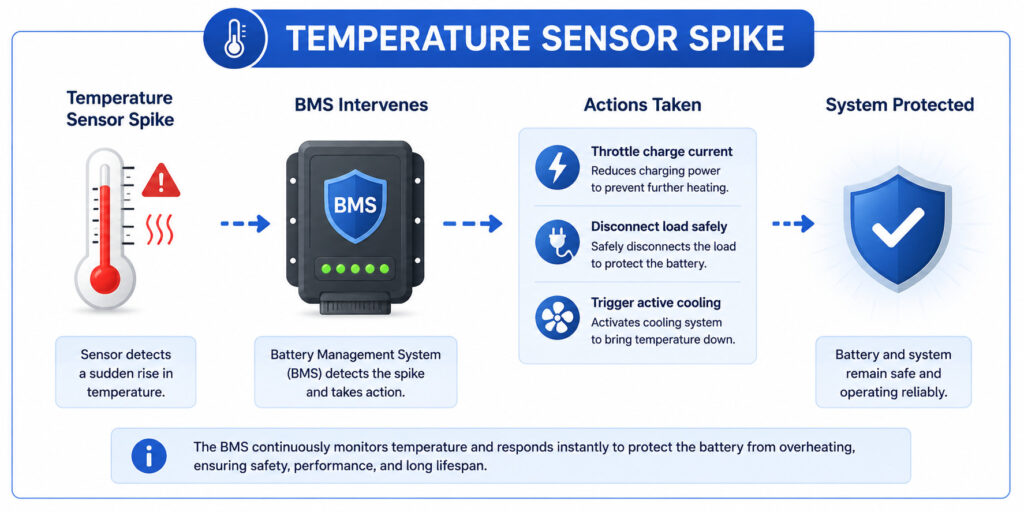
If the ambient environment gets out of hand, the BMS steps in to save the battery from itself:
- Thermal Throttling: If internal cell temperatures climb past 45℃ (113℉) during heavy charging, the BMS communicates with the solar inverter to automatically cut the charging rate in half, reducing the internal heat generation.
- Safety Cut-offs: If temperatures reach an unsafe extreme (typically around 55℃ to 60℃) the BMS will open its internal solid-state switches, completely disconnecting the battery from the system to prevent thermal runaway.
- Cold-Weather Lockout: If internal sensors detect temperatures at or below 0℃, the BMS will seamlessly block all incoming charging current from your solar panels while still allowing you to draw power out to keep your home running.
- Pro-Tips for System Longevity: How to Bulletproof Your Storage
When designing or installing a solar storage solution, you cannot change the outdoor weather—but you can completely control the microclimate where your batteries live. Proper engineering and installation strategy make all the difference.
Smart Location Selection
Never allow your battery bank to be installed in direct sunlight, on an exposed exterior wall that bakes in the afternoon sun, or in an unventilated attic space. The ideal location is a cool, ground-level utility room, a well-insulated garage, or a shaded, north-facing exterior enclosure.
Ventilation and Spacing
Airflow is the easiest way to prevent heat buildup. High-quality battery cabinets are designed with precise structural gaps between individual cells and modules.
- Always maintain the manufacturer-recommended clearance (usually at least 4 to 6 inches) between the battery cabinet and surrounding walls.
- Ensure the area has active or passive ventilation to pull hot air out of the space, especially during peak charging hours in the middle of the day.
Climate-Controlled Enclosures
For commercial or industrial installations where large battery containers sit outdoors in punishing environments, relying on passive airflow isn’t enough. These systems utilize active thermal management systems (HVAC or liquid cooling) to lock the battery room to exactly 25℃ year-round, ensuring maximum financial return on the asset.
Conclusion: Designing for the Real World
A solar battery storage system is a substantial investment meant to grant you energy independence, financial savings, and peace of mind. But on paper specifications only translate to reality if the system is designed to survive real-world environments.
When choosing a solar partner, look for teams that prioritize thermal engineering. Correct placement, proper ventilation spacing, and choosing highly stable cell chemistries like LFP are just as important as choosing the right capacity size. By keeping your battery comfortable, you ensure it keeps your lights on for years to come.
Ready to engineer a system built to last?
If you are planning an energy storage upgrade and want to ensure your setup is perfectly configured for your local climate conditions, contact our engineering team at Agni Solar. We build rugged, thermally optimized power systems designed to perform under pressure.